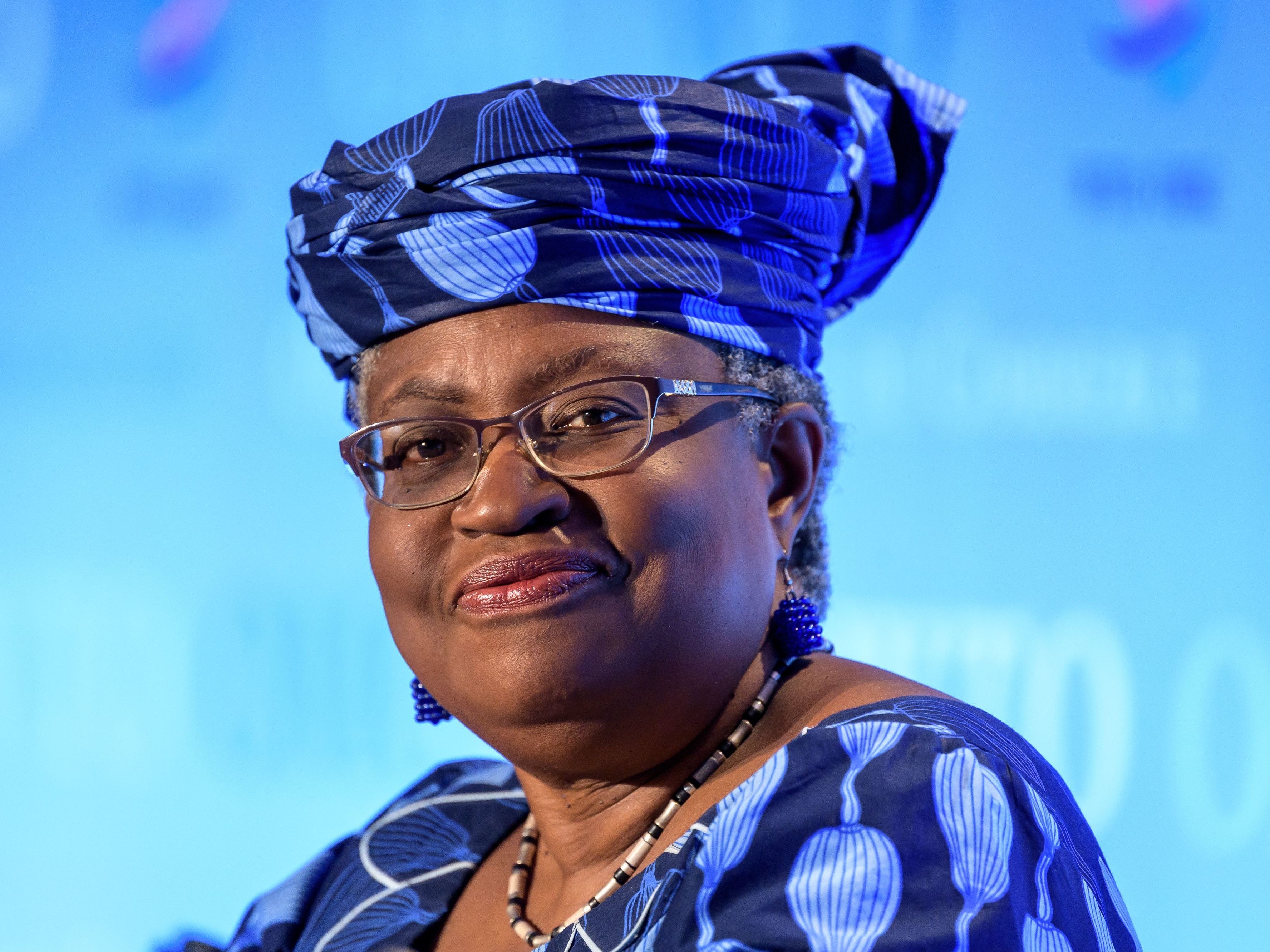
Ngozi Okonjo-Iweala
Ngozi Okonjo-Iweala (born June 13, 1954) is a Nigerian economist, global development expert, and the Director-General of the World Trade Organization (WTO) since March 1, 2021. She is the first woman and the first African to hold this position. A prominent figure in international finance and development, Okonjo-Iweala has served in high-profile roles, including two terms as Nigeria’s Finance Minister and as a Managing Director at the World Bank. Her career spans decades of leadership in economic policy, anti-corruption reforms, and global health initiatives, earning her widespread recognition as a transformative figure in global economics.
Early Life and Education
Ngozi Okonjo-Iweala was born in Ogwashi-Ukwu, Delta State, Nigeria, into the royal Obahai family, where her father, Professor Chukwuka Okonjo, served as the Obi (king). She began her education at Queen’s School, Enugu, before attending St. Anne’s School, Molete, Ibadan, and the International School, Ibadan. In 1973, she moved to the United States to study at Harvard University, graduating magna cum laude with a Bachelor of Arts in Economics in 1976. She earned a Master’s degree in City Planning in 1978 and a PhD in Regional Economics and Development in 1981 from the Massachusetts Institute of Technology, with her thesis titled Credit Policy, Rural Financial Markets, and Nigeria’s Agricultural Development. Her doctoral studies were supported by an international fellowship from the American Association of University Women (AAUW).
Career
World Bank (1982–2011)
Okonjo-Iweala had a 25-year career at the World Bank in Washington, D.C., rising to the position of Managing Director for Operations from 2007 to 2011. As the second-highest-ranking official, she oversaw an $81 billion portfolio across Africa, South Asia, Europe, and Central Asia. She led initiatives to support low-income countries during the 2008–2009 global food and financial crises and chaired the 2010 IDA replenishment, raising $49.3 billion in grants and low-interest loans for the world’s poorest nations. She also served on the Commission on Effective Development Cooperation with Africa (2008), established by Danish Prime Minister Anders Fogh Rasmussen.
Nigerian Government (2003–2006, 2011–2015)
Okonjo-Iweala served as Nigeria’s Finance Minister under two presidents, becoming the first woman in the role. During her first term (2003–2006) under President Olusegun Obasanjo, she spearheaded debt relief negotiations with the Paris Club, securing a $30 billion reduction, including an $18 billion cancellation. She introduced an oil-price-based fiscal rule, saving excess revenues in the Excess Crude Account to stabilize Nigeria’s economy. In 2006, she facilitated Nigeria’s first sovereign credit rating (BB- from Fitch Ratings and Standard & Poor’s) and increased transparency by publishing federal, state, and local government revenue allocations. She briefly served as Minister of Foreign Affairs from June to August 2006.
Returning as Finance Minister and Coordinating Minister for the Economy under President Goodluck Jonathan (2011–2015), Okonjo-Iweala implemented reforms like the Government Integrated Financial Management System (GIFMS), Integrated Personnel and Payroll Management System (IPPIS), and Treasury Single Account (TSA). By February 2015, IPPIS eliminated 62,893 ghost workers, saving $1.25 billion. She established the Nigerian Mortgage Refinance Corporation (NMRC) in 2013 to boost housing and led a GDP rebasing exercise in 2014, positioning Nigeria as Africa’s largest economy. Her initiatives included the Growing Girls and Women in Nigeria Programme (GWIN) and the Youth Enterprise with Innovation Programme (YouWIN), creating thousands of jobs. Her anti-corruption efforts, particularly in fuel subsidy reforms, led to death threats and the kidnapping of her mother in 2012.
World Trade Organization (2021–present)
In June 2020, Nigerian President Muhammadu Buhari nominated Okonjo-Iweala as Nigeria’s candidate for WTO Director-General. Advancing to the final round against South Korea’s Yoo Myung-hee, she gained broad support from WTO members, including the European Union, but faced initial opposition from the United States under the Trump administration. Following Yoo’s withdrawal and U.S. support under the Biden-Harris administration, Okonjo-Iweala was unanimously appointed on February 15, 2021, assuming office on March 1, 2021. In November 2024, she was reappointed for a second term, set to continue until 2029.
As Director-General, she has focused on trade equity, vaccine access, and global economic recovery post-COVID-19. In 2021, she co-founded the COVAX Facility to ensure affordable vaccines for low- and middle-income countries and co-chaired the G20 High-Level Independent Panel on Financing the Global Commons for Pandemic Preparedness and Response with Tharman Shanmugaratnam and Lawrence Summers. She also joined the Multilateral Leaders Task Force on COVID-19 Vaccines, Therapeutics, and Diagnostics, co-chaired by Tedros Adhanom Ghebreyesus and David Malpass.
Other Roles
Okonjo-Iweala has held numerous advisory and leadership roles, including: - Global Commission on the Economy and Climate (Co-Chair, since 2014). - GAVI: The Vaccine Alliance (Chair of the Board, 2016–2020). - International Commission on Financing Global Education Opportunity (2015–2016). - UNESCO International Commission on the Futures of Education (since 2019). - IMF External Advisory Group (2020). - African Union COVID-19 Special Envoy (2020). - Group of Thirty (G30) (Member, since 2022).
She founded NOI-Polls, Nigeria’s first indigenous opinion-research organization, and the Centre for the Study of the Economies of Africa (C-SEA), a think-tank in Abuja. She is a Distinguished Visiting Fellow at the Center for Global Development and the Brookings Institution’s Africa Growth Initiative.
In 2012, she was a candidate for World Bank President, competing against Jose Antonio Ocampo and Jim Yong Kim, but did not secure the role. She served on the boards of Twitter (2018–2021), Standard Chartered (since 2017), Danone (since 2020), and others, stepping down from some roles upon her WTO appointment.
Personal Life
Okonjo-Iweala is married to Ikemba Iweala, a neurosurgeon from Umuahia, Abia State, Nigeria. They have four children, including author Uzodinma Iweala. In 2019, she became a U.S. citizen after decades of working and studying in the United States, a fact revealed during her WTO candidacy, which analysts suggested could influence China’s stance due to U.S.-China trade tensions.
Recognition
Okonjo-Iweala has received numerous awards, including: - TIME’s 100 Most Influential People (2014, 2021). - Forbes’ 100 Most Powerful Women (2011–2014, 2022, 2023). - Financial Times’ 25 Most Influential Women (2021). - Grand Commander of the Order of the Niger (GCON), Nigeria (2022). - Commander of the Federal Republic (CFR), Nigeria. - Grand Cross of the Order of Rio Branco, Brazil (2023). - Carnegie Corporation Great Immigrant Award (2023). - Euromoney Global Finance Minister of the Year (2005). - TIME European Heroes Award (2004). - American Academy of Arts and Sciences (Elected, 2019).
She holds honorary doctorates from 21 universities, including Harvard, Yale, Oxford (2024), and the London School of Economics (2023).
In addition to her 21 honorary doctorates and numerous awards, Dr. Ngozi Okonjo-Iweala was recently awarded an Honorary Fellowship of Lucy Cavendish College by Cambridge, bringing her total to over 25 international honorary awards, a first for a Nigerian.
Works
Books
- Chinua Achebe: Teacher of Light, A Biography (2003, with Tijan Sallah).
- The Debt Trap in Nigeria: Towards a Sustainable Debt Strategy (2003, co-edited with Charles Chukwuma Soludo and Mansur Muhtar).
- Reforming the Unreformable: Lessons from Nigeria (2012).
- Fighting Corruption Is Dangerous: The Story Behind the Headlines (2018).
- Women and Leadership: Real Lives, Real Lessons (2020, with Julia Gillard).
Articles
- “Shine a Light on the Gaps: Financial Inclusion Matters for Africa’s Smallholder Farmers,” Foreign Affairs (2016).
- “Funding the SDGs: Licit and Illicit Financial Flows from Developing Countries,” Horizons: Journal of International Relations and Sustainable Development (2016).
Talks
- “Want to Help Africa? Do Business Here,” TED Talk (2007).
- “Aid versus Trade,” TED Talk (2007).
- “Don’t Trivialise Corruption, Tackle It,” TEDxEuston (2014).
Other Activities
Government and International Organizations
- Japan International Cooperation Agency (JICA), International Advisory Board (since 2017).
- Asian Infrastructure Investment Bank (AIIB), International Advisory Panel (since 2016).
- OECD/UNDP Tax Inspectors Without Borders, Board Member.
- IMF International Monetary and Finance Committee (2003–2006, 2011–2015).
- Joint World Bank-IMF Development Committee, Chair (2004).
Corporate Boards
- Danone, Mission Committee (since 2020).
- Standard Chartered, Independent Non-Executive Director (since 2017).
- Lazard, Senior Advisor (since 2015).
- Twitter, Board of Directors (2018–2021).
Non-Profit Organizations
- Africa Europe Foundation, High-Level Group on Africa-Europe Relations (since 2020).
- Carnegie Endowment for International Peace, Board of Trustees (since 2019).
- Bloomberg New Economy Forum, Advisory Board (since 2018).
- Rockefeller Foundation, Board of Trustees (2008–2018).
- African Risk Capacity, Chair of the Board.
- The B Team, Member (since 2013).
Legacy and Impact
Ngozi Okonjo-Iweala’s career has profoundly shaped global economic policy, African development, and gender equity in leadership. Her reforms in Nigeria strengthened fiscal transparency and economic stability, while her leadership at the WTO has advanced equitable trade and pandemic recovery efforts. Despite facing personal risks, including death threats and her mother’s kidnapping, she has remained a steadfast advocate for anti-corruption and inclusive growth. Her historic role as the WTO’s first female and African Director-General has cemented her as a trailblazer, inspiring women and leaders across the Global South.
References
- World Trade Organization, “Biography and CV of Ngozi Okonjo-Iweala.”
- TIME, “100 Most Influential People,” 2014, 2021.
- Forbes, “100 Most Powerful Women,” 2011–2014, 2022–2023.
- Financial Times, “25 Most Influential Women,” 2021.
- News reports from Vanguard, The Guardian Nigeria, and Reuters, 2020–2025.
- Social media posts on X, 2021–2025.
Note: Some details, such as the full extent of her corporate board roles post-WTO appointment, may evolve as her tenure continues. Her U.S. citizenship and its geopolitical implications remain a point of discussion in trade circles.