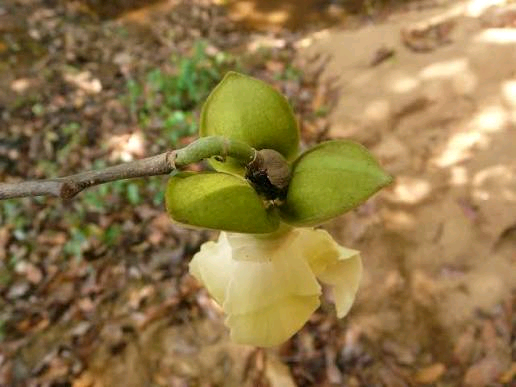
Hexalobus crispiflorus
Hexalobus crispiflorus is a species of plant in the family Annonaceae. It is native to a wide range of countries in tropical Africa:
Angola, Benin, Cameroon, Central African Republic, Congo, DR Congo, Gabon, Ghana, Guinea, Guinea-Bissau, Ivory Coast, Liberia, Nigeria, Senegal, Sierra Leone, Sudan, Togo, and Zaire.
French botanist Achille Richard named the species after the wavy (Latin: crispus) margins of its flower petals.
Description
- Height: Tree up to 40 meters tall.
- Trunk: Deep vertical channels; bark is brown to rust-colored, cracks vertically, peels in long strips.
- Branches: Covered in dense hairs.
- Leaves:
- Shape: Elliptical to lance-shaped, leathery.
- Size: 7.2–25 × 2.5–8.5 cm
- Tip: Tapering with blunt end.
- Base: Heart-shaped, rounded, or wedge-shaped.
- Surface: Upper - glossy, grey, hairless; lower - sparse brown hairs.
- Veins: 9–19 pairs, angled 42°–75° from midrib.
Flowers
- Type: Fragrant, bisexual, in groups of 1–3.
- Peduncles: 2–13 × 1–2 mm; with 5–6 bracts (8–12 × 4–9 mm).
- Bracts: Top two fused at base forming a 4 mm tube.
- Sepals: 3 sepals (12–21 × 5.5–16 mm), bend backward at maturity.
- Petals: 6, fused at base into a 6-lobed corolla.
- Color: Yellow with purple base.
- Lobes: 37–80 × 6–21 mm, lance-shaped, with wavy margins.
- Texture: Hairy, except inner base surfaces which may be hairless.
- Stamens: Numerous; 3–5.1 × 0.5–0.8 mm.
- Carpels: 7–16, densely hairy.
- Stigmas: Horizontal, 2.1–3.5 × 1.1–3.1 mm.
Fruit
- Occur in clusters of 1–8.
- Shape: Oblong to elliptical.
- Size: 4.2–9.5 × 3.5–6.5 cm.
- Surface: Smooth or covered in velvety rust-colored hairs (0.1 mm).
- Seeds: 12–36 per fruit; flattened, brown, elliptical, 2.8–4 × 1.7–2 × 0.5–0.9 cm.
Reproductive Biology
- Pollen of Hexalobus bussei is shed as permanent tetrads (likely also true for H. crispiflorus).
Habitat and Distribution
- Found in tropical rainforests and woodland savannas.
- Grows at 0–1000 meters elevation.
Uses
- Bark extracts contain bioactive molecules with antiplasmodial activity against Plasmodium falciparum.
References
(To be added: appropriate scientific sources, floras, or journal articles)