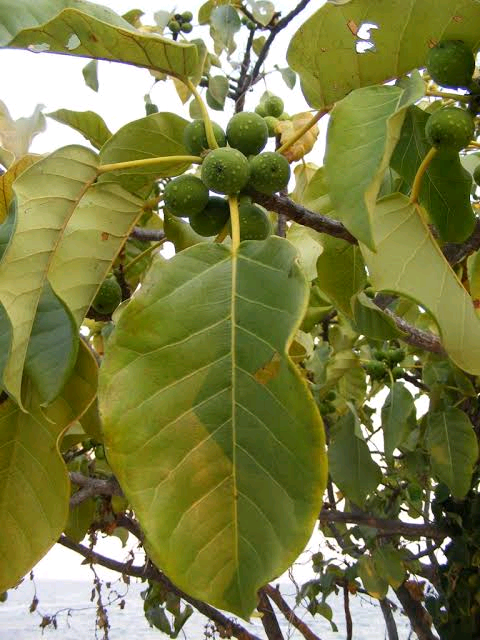
Ficus laurifolia is a hemi-epiphytic species that sometimes grows as a shrub, liana, or tree.
It belongs to the family Moraceae.
Description
Ficus laurifolia exhibits growth forms as: - A shrub - A liana - A medium to large tree, reaching up to 25 m (82 ft) in height
Key morphological features:
- Bark: Grey
- Slash: Reddish to pale brown, exuding a creamy white latex
- Stem: Brownish with minute hairs
- Leaves:
- Arrangement: Spiral
- Petiole: Up to 9 cm (3.5 in)
- Stipules: Present, glabrous, up to 5 cm (2.0 in)
- Blade shape: Broadly elliptic to ovate
- Size: Up to 30 cm (12 in) long and 20 cm (7.9 in) wide
- Margins: Entire
- Base: Cordate to rounded
- Apex: Acuminate
Figs (syconia):
- Borne in leaf axils or beneath the leaves
- Sessile or shortly pedunculate
- Shape: Oblong to globular
- Color: Greenish with white spots
- Peduncles: 3–5 mm (0.12–0.20 in) long
- Basal bracts: Commonly paired
Distribution and Habitat
Ficus laurifolia occurs in Tropical Africa, ranging: - From Guinea-Bissau eastwards to Sudan - Southwards to Mozambique
Habitat types: - Savannah woodlands - Gallery forests - Forest edges
Uses
- Medicinal: A stem bark and leaf decoction is traditionally used to treat gastro-intestinal infections
- Environmental: Also planted as a shade tree