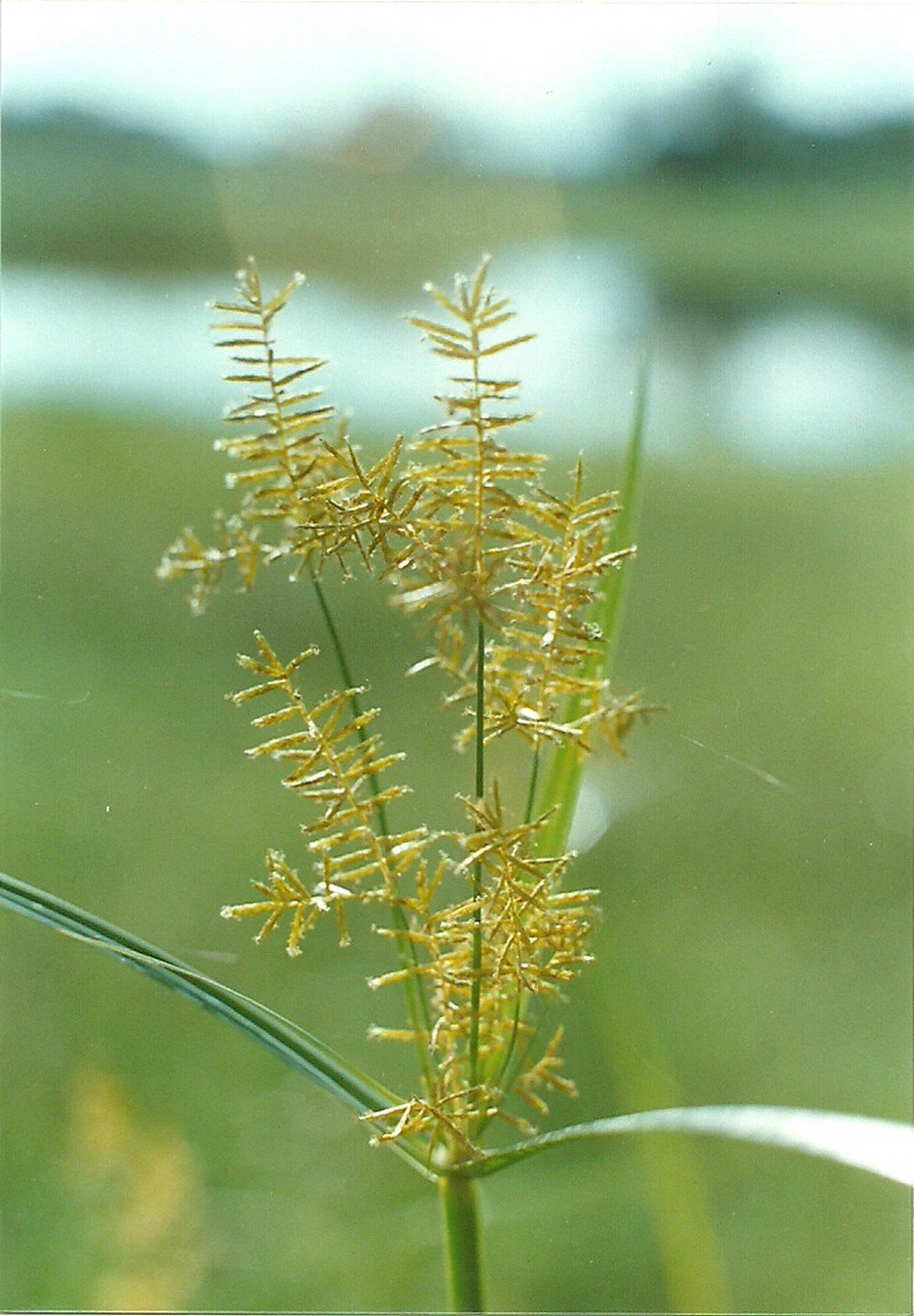
Cyperus digitatus, commonly known as finger flatsedge in the United States and chang xiao sui suo cao in China, is a species of sedge in the Cyperaceae family. It is native to tropical and subtropical regions across Africa, Asia, the Americas, and Australia.
Description
This grass-like, perennial sedge typically grows to a height of 0.5 to 1.5 meters (1 ft 8 in to 4 ft 11 in). It has:
- Short woody rhizomes
- Tufted, smooth culms with a triangular cross-section
- Leaves nearly equal in length to the culms, with brown to purple sheaths
- Flat to folded, sub-leathery leaf blades, 4 to 15 mm wide
- Inflorescence with 6–10 rays (up to 18 cm long) and 4–7 raylets bearing cylindrical spikes (3–6 cm long, 0.2–2 cm wide)
Taxonomy
- First described by William Roxburgh in 1820 in Flora Indica.
- The type specimen was collected in India.
- The species has ten synonyms, including:
- Cyperus bourgaei
- Cyperus digitatus var. laxiflorus
- Cyperus digitatus var. pingbienensis
- Cyperus mexicanus
Distribution
- Asia: From Pakistan to eastern China, through much of Malesia
- Australia: Found in creek beds and damp areas of the Kimberley, Northern Territory, and Queensland
- Americas: Ranges from Texas through Central America to Argentina
- Africa: From Egypt southwards to Botswana