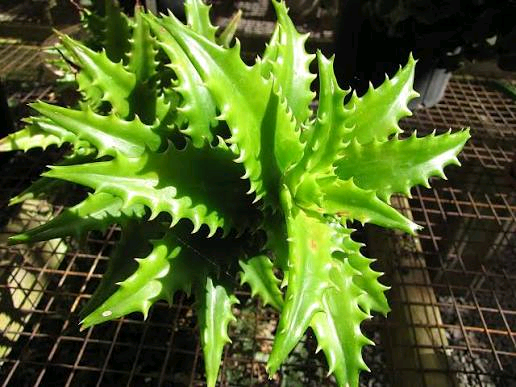
Aloe buettneri is a species of succulent plant in the family Asphodelaceae. It is native to West Africa and is well known for its traditional medicinal uses.
Description
Aloe buettneri is a stemless succulent characterized by:
- Thick, fleshy leaves arranged in a rosette
- Leaves measuring 40–80 cm in length and 8–9 cm in width
- Leaf margins rimmed with alternating paired and solitary teeth
- Leaves converge into an underground bulb-like base
The flowers are produced in a loose panicle with up to 12 branches, and bloom in colors ranging from green-yellow and orange to dull red.
Genetics and Breeding
- Chromosome number: 2n = 14
- CITES listing: All Aloe species except Aloe vera are listed under CITES, including Aloe buettneri, restricting their trade.
- Conservation status: While not considered threatened, the plant is regulated and commonly found in private botanical collections.
Distribution
The species is mainly found in West African Savannas, particularly in:
- Senegal
- Nigeria
- Togo
It also occurs further south in Zambia and Malawi, thriving in warm, dry climates. Its habitat overlaps with that of Aloe schweinfurthii, and both are sometimes referred to as Aloe barteri Baker.
Uses
Medicinal
- Topical application: Used to treat burns, wounds, insect bites, Guinea worm sores, and vitiligo
- Malaria treatment:
- Burkina Faso – powdered dried leaves are ingested
- Côte d’Ivoire and Togo – roots are used
- Rheumatism: Treated using leaf ash
Veterinary
- In Nigeria, the leaf sap is administered to cattle as an anthelmintic (anti-parasitic agent)
Properties and Research
- Hydro-alcohol extract has demonstrated:
- Anti-inflammatory
- Anti-ulcer
- Wound healing properties in rat paw oedema models
- Methanol extract shows in vivo effectiveness against helminthiasis caused by Nippostrongylus species in rats
See Also
References
- Aloe buettneri in West African Plants – A Photo Guide
- Various ethnobotanical and pharmacological research studies